
Food Safety Bites with Beth
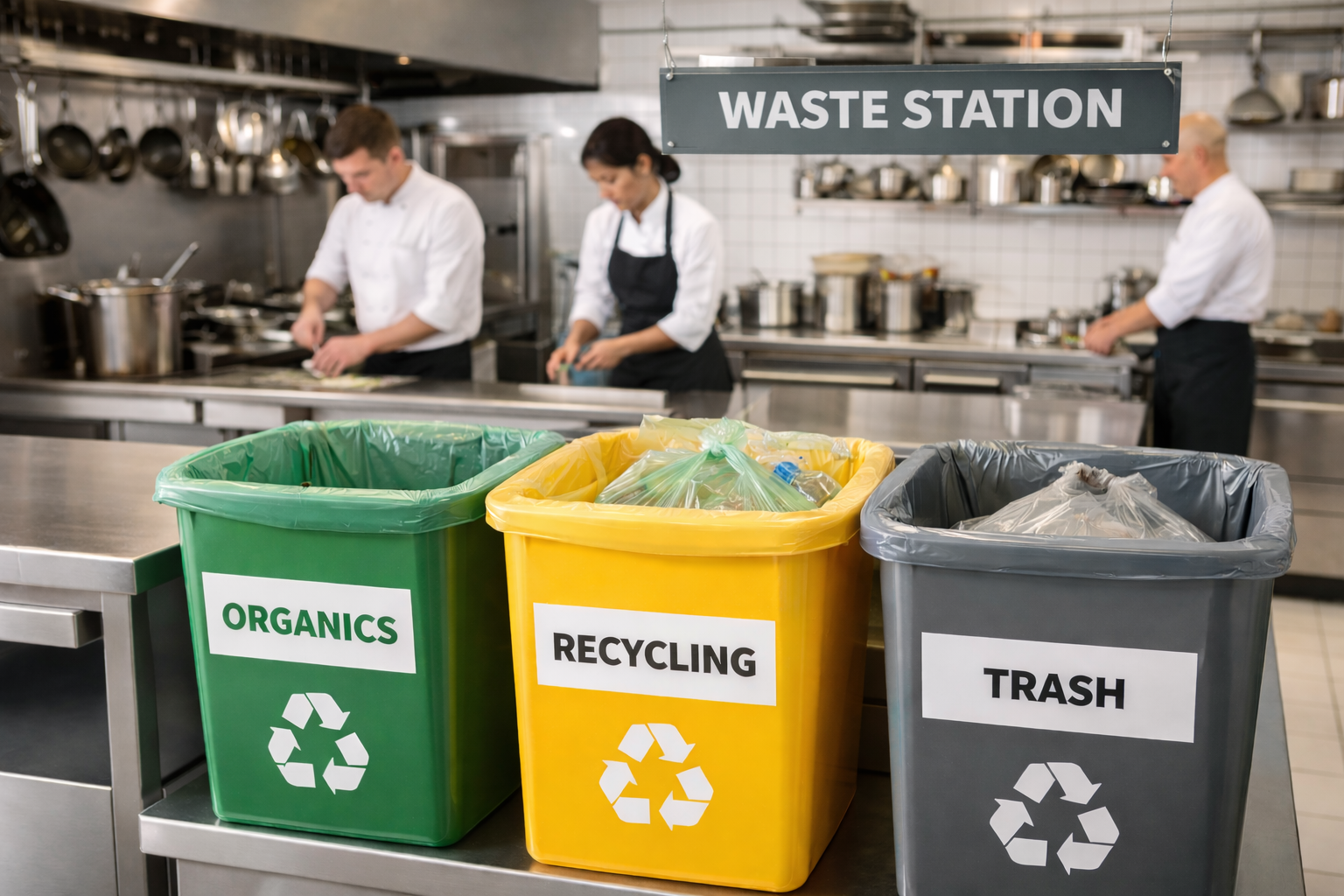
Proper waste management is essential to maintaining a clean, safe, and compliant food service operation. When trash is handled correctly, it prevents pests, odors, cross-contamination, and health code violations. A clean kitchen doesn’t happen by accident because it starts with how we manage waste every single day.
After completing this training, employees should be able to:
- Explain why proper waste management is critical to food safety.
- Identify requirements for indoor and outdoor trash containers.
- Demonstrate proper procedures for removing and handling trash.
- Prevent cross-contamination related to waste handling.
- Describe best practices for recycling and waste separation.
- Recognize conditions that attract pests and how to prevent them.
A Clean Kitchen Starts with Proper Waste Management
- Trash must be removed from food prep areas as often as necessary to prevent overflow and contamination.
- Indoor trash cans should:
- Be durable, leak-proof, and non-absorbent.
- Be easy to clean.
- Have tight-fitting lids in most food prep areas.
- Be lined with appropriate garbage bags.
- Outdoor dumpsters and waste containers should:
- Have tight-fitting lids and remain closed when not in use.
- Be placed on a non-absorbent surface such as concrete or asphalt.
- Be kept clean and free of excessive buildup.
- Be located away from building entrances whenever possible.
- Trash bags should be securely tied before removal.
- Employees must wash their hands after handling trash and before returning to food prep.
- Never carry trash and food through the same pathway at the same time.
- Cardboard and recyclables should be broken down and stored properly to reduce pest harborage.
- Grease and oil must be disposed of in designated containers—not in sinks or storm drains.
- Spills around dumpsters should be cleaned immediately.
- Overflowing trash is a leading cause of pest activity and health inspection violations.
- Waste areas should be included in daily cleaning schedules.
Take Action! Try these FREE training activities.
Trash Walk-Through Inspection
Walk through the facility with employees and inspect all indoor and outdoor waste areas. Have employees identify potential problems such as missing lids, overflowing bins, leaks, food debris on the floor, or open dumpster lids. Discuss corrections immediately and assign responsibility for ongoing monitoring
Proper Trash Removal Demonstration
Demonstrate the correct way to remove a trash bag: tie it securely, avoid dragging it across the floor, carry it away from food prep areas, and immediately wash your hands afterward. Then have employees practice the process. Emphasize what should never happen, such as handling trash and then returning to food prep without handwashing.
Pest Prevention Challenge
Divide employees into small groups and ask them to list ways trash can attract pests. Then challenge them to create solutions. For example, keeping dumpster lids closed, cleaning spills, removing trash frequently, and breaking down cardboard. Discuss how small daily habits prevent major pest problems.
Flow of Traffic Exercise
Using a simple floor diagram of your facility, have employees mark the route for taking out trash. Discuss how to avoid crossing paths with food deliveries or prepared food. Reinforce the importance of preventing cross-contamination during waste removal.
Dumpster Detail Drill
Take the team outside and conduct a focused inspection of the dumpster area. Ask employees to evaluate lid condition, cleanliness, placement, surrounding ground surface, and signs of pests (droppings, chew marks, flies, odors). Have them create a quick corrective action plan on the spot. This activity reinforces that the dumpster area is part of the kitchen—and inspectors absolutely treat it that way. Download your FREE Dumpster Detail Drill Activity Sheet.
The 60-Second Response Challenge
Present various scenarios regarding waste management. Give employees 60 seconds to outline exactly what should happen next. Who blocks the area? Who cleans it? What chemicals are used? When are hands washed? Discuss their answers and clarify expectations. This activity builds quick thinking and reinforces that spills must be handled immediately to prevent slips, contamination, and pest attraction. Download your FREE 60-Second Response Challenge.
Keep it Going!
- Conduct weekly inspections of indoor and outdoor waste areas.
- Assign clear responsibility for dumpster checks and cleaning.
- Monitor that lids remain closed and containers are not overflowing.
- Review trash removal procedures during new employee orientation.
- Schedule periodic refresher training on waste and pest prevention.
- Document corrective actions when waste issues are identified.
- Include waste areas in daily and weekly cleaning checklists.
When waste is managed properly, the entire operation runs more smoothly. Clean trash areas reduce pests, prevent contamination, and demonstrate professionalism. A clean kitchen truly does start with proper waste management—thank you for committing to excellence in sanitation and food safety.
Ready to take your team’s training to the next level? TSC Associates offers customized, private training tailored to your specific operation. Our experienced instructors and flexible training formats ensure your staff builds practical skills and a strong understanding of regulatory requirements—helping you stay compliant and maintain a safe, efficient environment.
Contact TSC Associates to learn more about our customized training programs, as well as our ServSafe® courses and certification options.
Created by Beth Brewer, TSC Associates LLC
Resources
1. Waste Management Schedule Free download from FoodDocs.com.
2. Waste Management Plan Free Waste Management Plan template from FoodDocs.com.
3.FDA Food Code 2022 (Chapter 5) Official guidance outlining requirements for indoor and outdoor waste containers, dumpster placement, and maintenance standards in food establishments.